

Salt: Essential Mineral for Flavor and Health
Salt enhances flavor, preserves food, and maintains the body’s fluid balance — but too much can raise blood pressure.
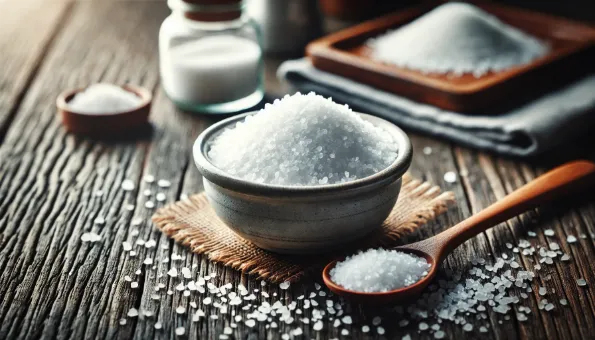
What Is Salt?
Salt is primarily composed of **sodium chloride (NaCl)**, an essential mineral used worldwide for seasoning and preserving foods. It plays a vital role in maintaining fluid balance, nerve function, and muscle contraction.
Types of Salt
- **Table salt** – refined and often iodized.
- **Sea salt** – derived from evaporated seawater; contains trace minerals.
- **Himalayan pink salt** – mined from ancient salt deposits; rich color from iron oxide.
- **Kosher salt** – coarse texture, ideal for cooking and curing.
Nutritional Value (per 1 g)
- **Sodium:** ~390 mg
- **Calories:** 0 kcal
- **Other minerals:** trace magnesium, calcium, potassium (in unrefined types)
Benefits
- Maintains **electrolyte balance**.
- Supports **nerve transmission** and **muscle contractions**.
- Enhances **taste perception** and aids **food preservation**.
Risks of Excess Intake
- High intake may cause **hypertension (high blood pressure)**.
- Excess sodium linked to **heart and kidney disease**.
- Recommended daily limit: **≤ 5 g (2 g sodium)** according to WHO.
Culinary Uses
- Used in **seasoning**, **brining**, **pickling**, and **baking**.
- Enhances flavor synergy with acids and fats.
Summary
Salt is both a vital nutrient and a flavor enhancer — best enjoyed in moderation to maintain optimal health.
- 1. Salt
Salt (so): neophodan mineral za ravnotežu elektrolita, okus i konzervaciju hrane.